Order in the Chaos: How Cells Navigate Broken Genomes
Information essential for life is encoded within DNA, yet this molecule is constantly challenged by diverse sources of damage. Our research program asks how microbial cells regulate DNA damage repair in space and time, using high-resolution imaging to track replication, recombination and repair inside individual cells. In this talk, I will focus on double-strand break repair by homologous recombination, centred on homology search, in which a RecA nucleoprotein filament must locate a matching sequence within a crowded genome. Our work shows that homology search is not a passive, diffusive scan but an actively organised process unfolding in two steps. First the filament must encounter its candidates, a problem of movement. We find that the SMC-like protein RecN acts as a DNA motor, driving filaments in long-range, back-and-forth sweeps across the cell, with a conserved DNA helicase an essential partner in this motion. A chance encounter must then become a commitment, and here the genome’s own topology supplies the selectivity. RecA filaments overwhelmingly favour negatively supercoiled targets, so that supercoiling, not mere proximity, finally licenses a faithful pairing. Together these pieces describe a coordinated apparatus for moving genetic information faithfully within a cell. Indeed, the same recombination machinery can move information between cells as well, and the very processes that protect genetic information are also the ones that move and reshape it.
Short bio
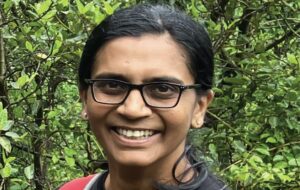
Anjana is an Associate Professor at the National Centre for Biological Sciences (NCBS-TIFR) in Bangalore India, where her group investigates the molecular mechanisms that maintain and reshape microbial genomes. Anjana studied for a PhD at the University of Oxford and carried out a postdoctoral fellowship at the Massachusetts Institute of Technology before starting her own research group at NCBS in 2017. She has been recognized with honours including the Infosys Prize in Life Sciences, fellowship to the Indian Academy of Sciences and the INSA Young Scientist Medal. She is presently at Imperial College as an Schmidt Global Faculty Fellow.
Laboratory of the speaker
National Centre for Biological Sciences (Bengaluru, India)
Invited by
Manish Kushwaha