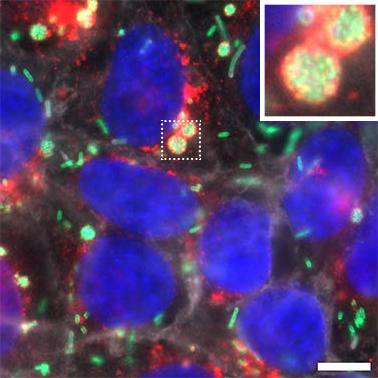
Listeria monocytogenes (Lm) is a widespread pathogenic bacterium that causes listeriosis, a rare foodborne disease with one of the highest mortality rates among foodborne infections. Lm was long thought to live only in the cytosol of infected cells, but it is now known that it can also persist inside vacuolar compartments called LisCVs (Listeria-containing vacuoles). In these compartments, the bacterium can enter a dormant state, which may help it remain in tissues for long periods.
In a study published in PLOS Pathogens, scientists from Micalis Institute (Université Paris-Saclay/INRAE/AgroParisTech, Jouy-en-Josas), in collaboration with ANSES, investigated the mechanisms involved in this intracellular persistence. The researchers screened more than one hundred strains isolated from environmental and clinical sources. Using fluorescence microscopy, they studied several features linked to persistence, including intracellular motility, cytotoxicity, and the presence and size of LisCVs. Their results showed that persistence in epithelial cells is a common feature of Lm, suggesting that it may be an ancestral characteristic related to its pathogenicity.
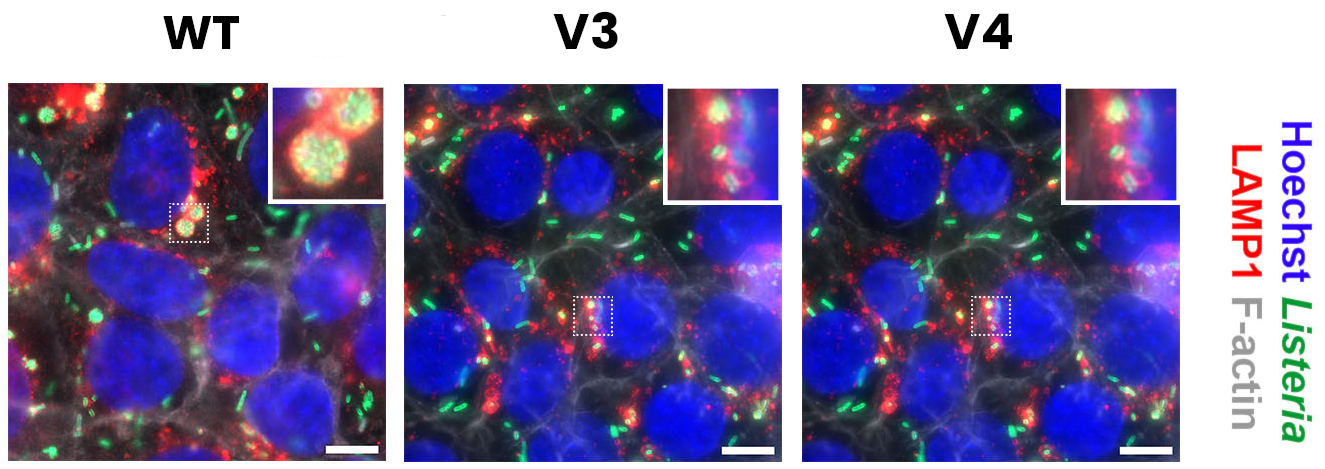
The researchers also identified two isolates with reduced persistence. These variants were less often associated with LisCVs, which were also smaller in size. Comparative genomic analysis showed that this phenotype was caused by a single mutation in the essential folP gene, which is involved in folate synthesis. Fluorescence microscopy and live-cell imaging further revealed that folate deficiency impairs bacterial motility, explaining this low-persistence phenotype.
These results improve our understanding of Listeria persistence, a still poorly understood lifestyle that may help the bacterium spread silently.
Contact:
Eliane Milohanic, Alessandro Pagliuso
Links:
Lotoux A, Bertrand M, Douarre P-E, Kortebi M, Riveiro H, Palma F, et al. (2026) Large-scale phenotyping and comparative genomics reveal genetic features of Listeria persistence in epithelial cells. PLoS Pathog 22(4): e1013323. https://doi.org/10.1371/journal.ppat.1013323