I
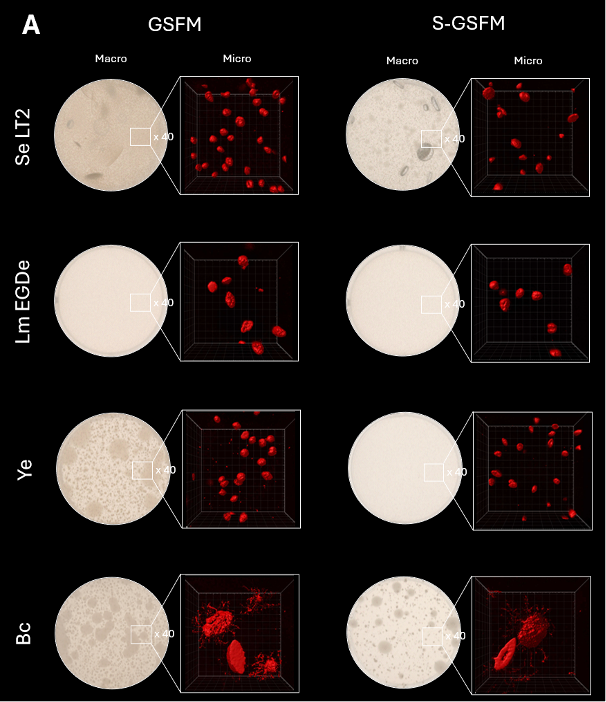
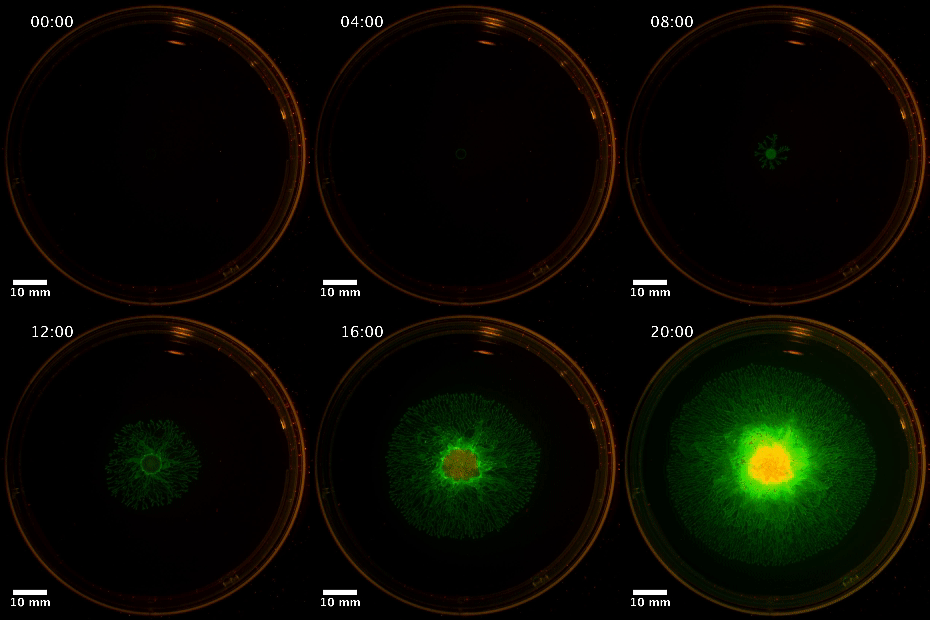
Microbial communities are far more than simple collections of cells. Their spatial organization profoundly shapes their physiology, interactions, and collective functions. Our goal is to understand how the architecture of biofilms and other spatially organized microbial communities gives rise to emergent properties that cannot be explained by the behavior of individual cells alone.
To address this challenge, we combine multidimensional imaging, genetics, spatial transcriptomics, biophysics, and microbial ecology within an integrated research framework. These complementary approaches enable us to visualize, at single-cell resolution, the spatial organization of microbial populations, physiological gradients, gene expression programs, and the interactions that emerge within structured communities.
Our research focuses on cellular differentiation, phenotypic heterogeneity, interspecies interactions, collective motility, and the mechanisms that govern the resilience, adaptation, and evolution of spatially organized microbial communities. This fundamental understanding provides the foundation for developing innovative strategies to control harmful biofilms or harness beneficial microbial communities in food systems, health, and biotechnology.
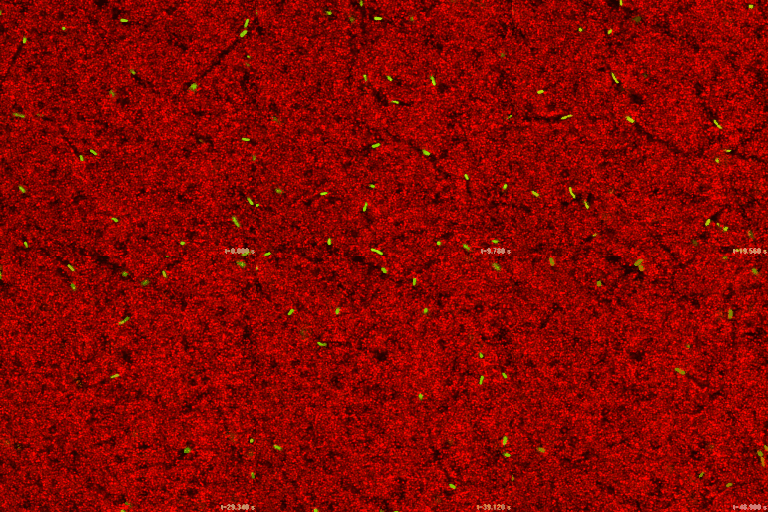
Biofilms and spatially organized microbial communities respond very differently to treatments than planktonic cells. Their three-dimensional architecture, extracellular matrix, physiological heterogeneity, and complex interactions between microbial populations confer a remarkable capacity for adaptation and resilience. Developing effective control strategies therefore requires considering these communities as complex biological systems rather than as simple collections of individual cells.
Our research aims to develop innovative approaches for controlling structured microbial communities. We investigate the mechanisms underlying biofilm tolerance and resilience, the interactions between antimicrobial compounds, and the responses of microbial communities to physical, chemical, and biological stresses. We also develop biocontrol strategies based on microbial interactions, harnessing beneficial communities that can sustainably prevent the establishment or persistence of undesirable microorganisms.
These studies contribute to the development of more effective and sustainable solutions for controlling biofilms in food systems, healthcare, biotechnology, and extreme environments.
 The B3D team is a partner of the ACTIA joint Technological Unit entitled “FASTYPERS”. A Mixed Technology Unit (UMT) is a partnership tool between public research units and technical institutes, established and supported by the Ministry responsible for Food under the coordination of ACTIA. Listeria monocytogenes and Salmonella spp are two major foodborne pathogens. Food contamination can originate from either plant or animal raw materials and the food processing environment. The ability of these pathogens to adapt to stress, grow at low temperatures, form biofilms and then persist in food processing facilities for years has made these two pathogens a major challenge for food safety. Successful control of these bacterial strains in the food chain requires appropriate cleaning and sanitation programs. Biocides play an important role in limiting the spread of bacterial pathogens. However, some strains can resist sanitation processes.
The “FASTYPERS” UMT was created in France to gain a deeper insight into the contamination of the pork and dairy sectors for these two pathogens, in a One Health approach. FASTYPERS is a 5-year project involving the French Agency for Food, Environmental and Occupational Safety (ANSES), the National Institute for Agriculture, Food and the Environment (INRAE), the French Institute for Food Safety and Dairy Products (ACTALIA) and the French Institute for Pig and Pork Products (IFIP). The main objectives are:
These strains will be phenotypically tested for biocide resistance and biofilm formation. Genome-wide association studies (GWAS) will identify key genetic markers that contribute to the adaptation of strains in food crops. These markers will then be used to develop two state-of-the-art molecular tools, GenoListeria1 and GenoSalmo2. In a single analysis, these tools will help us detect resistant strains that may persist in food processing facilities. These tests will help the food industry make food processing decisions to improve food safety.
The INRAE Micalis Institute and Lallemand Animal Nutrition (LAN) are pleased to announce the creation of the LabCom “Biofilm1Health,” a collaborative laboratory focused on unlocking the potential of biofilm properties in beneficial microbes. This cutting-edge partnership between the B3D team from the Micalis Institute (UMR 1319 INRAE, AgroParisTech, Université Paris-Saclay) and LAN, with support from the French National Research Agency (ANR), aims to advance the One Health concept, a holistic approach that integrates human, animal, and environmental health.
The mission of LabCom “Biofilm1Health” is to explore the unique properties of beneficial biofilms-complex microbial communities that offer protection and enhanced functionality. By investigating how these biofilms can reduce harmful microorganisms in livestock, food production, and the environment, the initiative seeks to provide sustainable and effective microbial solutions. A defining aspect of this project is its incorporation of advanced biofilm phenotyping and artificial intelligence to enhance our understanding of these intricate ecosystems.
The ultimate goal is to optimize the application of beneficial biofilms to create next-generation solutions that improve sustainability, reduce the need for chemical interventions, and support animal welfare.
The project is structured around four key research axes:
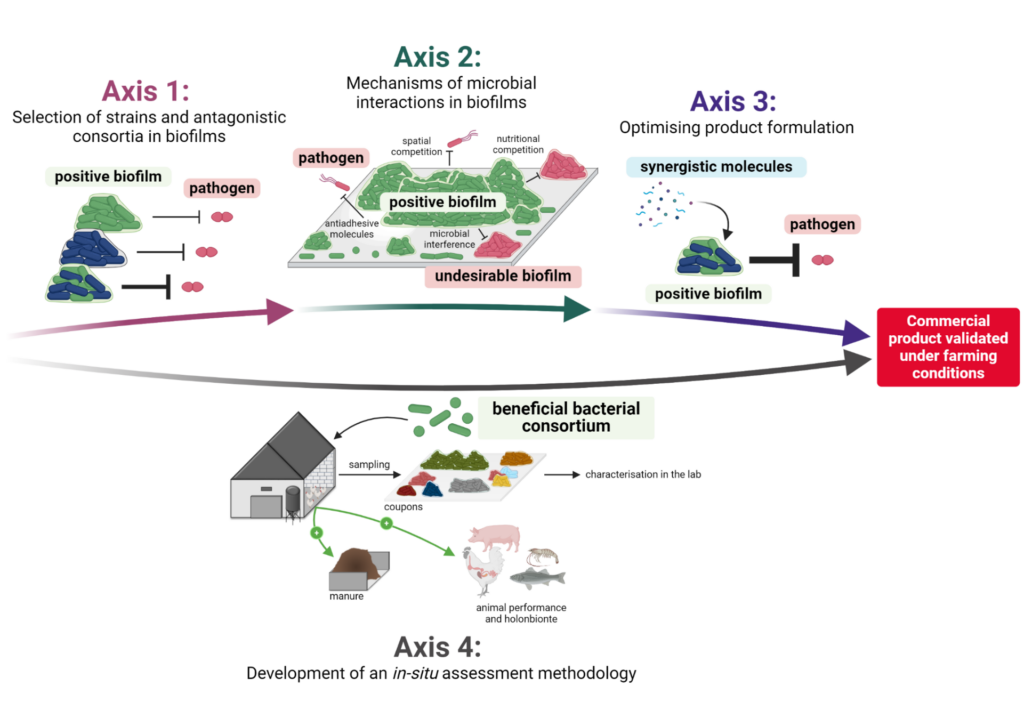 A strategic partnership driving scientific and industrial innovation
The B3D team at the Micalis Institute is internationally recognized for its pioneering research on biofilms and spatially organized microbial communities. Their work focuses on understanding the complex relationships between microbial community structures and their emergent properties, particularly in biofilm and food-related environments. By exploring phenotypic heterogeneity and interspecies interactions, the B3D team aims to develop novel preventive and curative strategies that can be applied to industries ranging from food production to healthcare and aerospace.
Lallemand Animal Nutrition has been at the forefront of microbial solutions for animal nutrition since the 1980s, including the introduction of the first registered probiotics in Europe for ruminant and monogastric animal feeds. Today, LAN plays a leading role in animal nutrition and environmental management in sectors such as ruminant, pig, poultry, aquaculture, equine, and pet nutrition. Through strategic collaborations and its Blagnac laboratory, LAN continues to innovate by developing products that harness beneficial microorganisms for both nutrition and livestock management.
The creation of LabCom “Biofilm1Health” signals the dawn of a new chapter in microbial innovation, where the combined expertise of INRAE and Lallemand Animal Nutrition will drive forward solutions that benefit human, animal, and environmental health. By unlocking the potential of biofilms and leveraging cutting-edge digital tools, this collaboration will contribute to sustainable practices across multiple industries. The research carried out at LabCom “Biofilm1Health” promises to not only deepen our understanding of microbial ecosystems but also pave the way for transformative solutions that reduce chemical inputs, enhance animal welfare, and promote a healthier planet.
LabCom “Biofilm1Health” is funded by the French National Research Agency .